AI tools for neurology.
The tools we build at Neuro.Wiki and NeuroEvidence, and a short list of outside tools we find useful for brain imaging, EEG and the literature. For education and research.
Built by Neuro.Wiki and NeuroEvidence
Brain Mapper
Load a 3-D T1 brain MRI and explore every lobe, gyrus and deep nucleus in three linked planes, with concise clinical notes for each structure.
Map a brain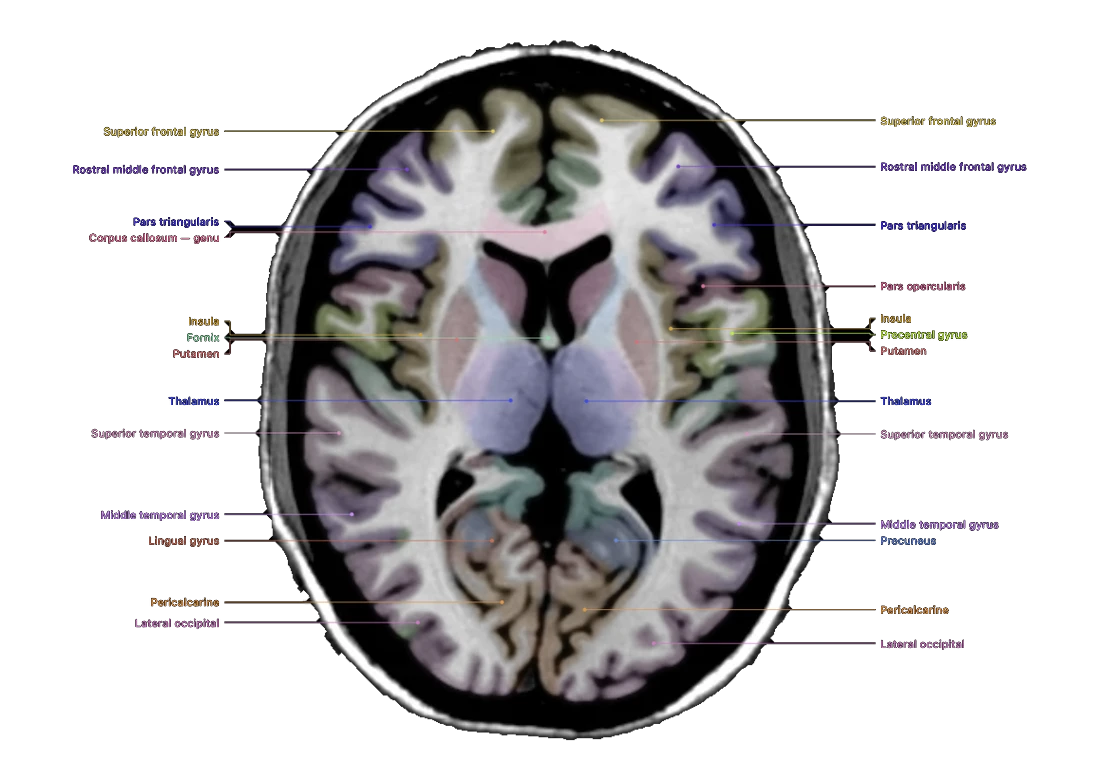
Angio Mapper
Drop a cerebral angiogram and see every artery outlined in seconds. Text is removed in your browser first; the image is never stored.
Map an angiogram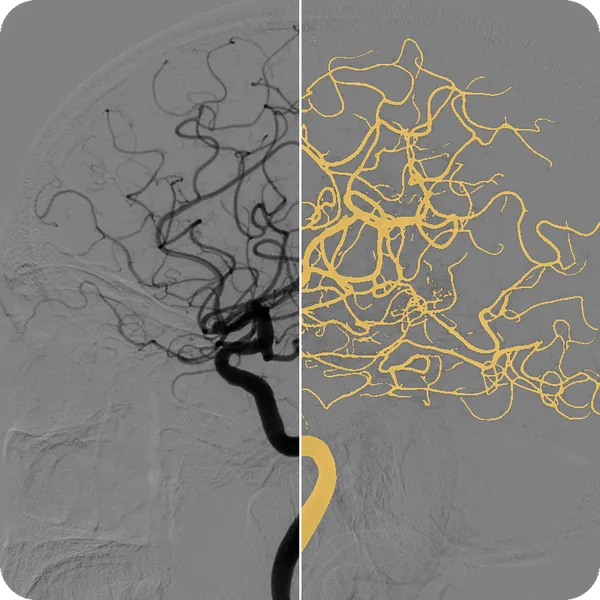
Useful tools from other teams
Brain MRI segmentation
- FreeSurferMartinos Center, Massachusetts General Hospital
The long-standing research suite for cortical surfaces, cortical thickness and brain segmentation on structural MRI.
- FastSurferDZNE (German Center for Neurodegenerative Diseases)
Deep-learning brain segmentation and surfaces, compatible with FreeSurfer, in minutes rather than hours.
- SynthSegBillot et al., part of FreeSurfer
Segments brain scans of any contrast and resolution, including routine clinical MRI, without retraining.
- BrainChopTReNDS Center, open source
Brain extraction and segmentation that runs entirely in the web browser.
Medical imaging AI
- TotalSegmentatorWasserthal et al., University Hospital Basel
Segments more than 100 anatomical structures on CT and MRI.
- nnU-NetGerman Cancer Research Center (DKFZ)
A self-configuring framework that sets up and trains a segmentation network for a new dataset.
- MONAIProject MONAI, open source
A PyTorch framework for building, training and deploying medical-imaging AI.
Image viewers
- 3D SlicerSlicer community, open source
A free desktop platform to view, segment and measure medical images, with AI extensions.
- ITK-SNAPUniversity of Pennsylvania and University of Utah
A lightweight viewer for manual and semi-automatic 3-D segmentation.
- NiiVueNiiVue team, open source
A fast web viewer for MRI and CT volumes with overlays, usable in any browser.
- MRIcroGLChris Rorden, University of South Carolina
Slice viewer and 3-D volume rendering for NIfTI and DICOM images.
EEG
- MNE-PythonMNE developers, open source
EEG and MEG analysis: preprocessing, time-frequency and source localisation.
- EEGLABSCCN, University of California San Diego
A MATLAB toolbox for EEG processing, including independent component analysis for artifact removal.
Literature search
- Semantic ScholarAllen Institute for AI
Free AI-assisted search across scientific papers, with one-line paper summaries.
- ElicitElicit
Finds papers and pulls study details into tables for evidence reviews.
- ConsensusConsensus
Answers research questions with summaries drawn from peer-reviewed papers.
Outside tools are listed for information only. We are not affiliated with them and do not endorse them; names belong to their owners. Check each tool’s licence and intended use: most are research software, not medical devices.
Labs tools are for education and research, separate from NeuroEvidence’s clinical answers. Not medical devices; not for diagnosis or treatment. © 2026 NeuroEvidence.ai